
You saw one. Maybe it was 2am in the kitchen. Maybe it scurried behind the fridge before you could process what you were looking at. And now you’re here, wondering how bad the situation actually is.
Here’s the honest answer: if you saw one cockroach, there are more. A lot more. Cockroaches hide so well that by the time you spot a single one in the open, the colony behind your walls and inside your appliances has already been growing for weeks.
This is the most complete cockroach guide written specifically for Dubai properties — covering every species found here, their biology, life cycles, behavior, health risks, and exactly what it takes to eliminate them permanently.
Need help now? Book a free inspection with Dominator Pest Control: 📞 +971 56 968 6078
Why Cockroaches Are a Bigger Problem in Dubai Than Most Cities
Most cities have seasonal pest cycles. Dubai doesn’t. The heat here — regularly exceeding 40°C from May through September — doesn’t slow cockroaches down. It accelerates everything: their breeding cycle, their movement speed, and their spread across buildings.
Dubai’s building density compounds the problem. In apartment towers, cockroaches don’t stay in one unit. They travel freely through shared plumbing, wall voids, and ventilation systems. Treating one apartment while neighboring units remain infested is the single biggest reason people in Dubai get repeat infestations after treatment.
And then there’s delivery culture. Every cardboard box entering your kitchen — groceries, restaurant supplies, appliance shipments — is a potential transport vehicle for German cockroaches. This species doesn’t fly in through windows. It rides in.
Cockroach Biology: Key Facts That Explain Why They’re So Hard to Kill
Understanding cockroach biology isn’t just interesting — it directly explains why DIY treatments fail and what professional treatment actually targets.
- Cockroaches have existed on Earth for over 300 million years, surviving conditions that wiped out far more complex species
- They can survive up to one month without food but only one week without water — which is why moisture control matters more than food sealing alone
- A cockroach can hold its breath for up to 40 minutes — one reason liquid drain treatments miss them
- They can flatten their bodies to fit through gaps as small as 1.6mm — thinner than a coin
- Cockroaches are thigmotactic: they instinctively prefer tight spaces where surfaces press against their bodies on all sides. This is why they nest inside appliance motors, cabinet hinges, and wall cracks rather than open areas
- They can run at approximately 5 km per hour relative to body size
- A single female German cockroach can produce up to 300,000 offspring in one year
Cockroach Anatomy: Understanding Their Body
Knowing cockroach body parts helps you identify species accurately and understand how they behave and survive.
Head: Contains the mouthparts (used for chewing solid food), compound eyes that detect light and movement, and two long antennae used for sensing smell, temperature, humidity, and air movement. The antennae are constantly in motion — they’re the cockroach’s primary navigation tool.
Pronotum: The plate-like shield directly behind the head. Markings on the pronotum — stripes, patterns, color variations — are the key identification feature for most species.
Thorax: The middle body section where all six legs attach. Each leg has spines used for grip on smooth and rough surfaces alike. Cockroaches can walk on walls and ceilings because of specialized pads on their feet.
Wings: Most species have two pairs of wings. The outer wings (tegmina) are leathery and protective. The inner wings are membranous and used for flight. Many species have wings but rarely or never fly — wings are not a reliable indicator of flight ability.
Abdomen: Contains the digestive system, reproductive organs, and — in females — the ootheca (egg case). The abdomen also contains spiracles: small openings used for breathing, which is why cockroaches can survive being submerged briefly.
Cerci: Two short appendages at the tail end of the abdomen. These are sensory organs that detect air movement behind the cockroach — they’re part of the escape reflex that makes cockroaches so difficult to catch.
What Do Cockroaches Eat?
Cockroaches are omnivores and scavengers. They will eat almost anything organic — but understanding their food preferences explains where to look for activity and what conditions to eliminate.
Preferred food sources:
- Starchy foods: bread, cereals, pasta, rice
- Sugary substances: fruit, sugary drinks, confectionery residue
- Grease and cooking oils behind ovens and under fryers
- Meat and protein: leftover food scraps, pet food
- Dead insects and other cockroaches (yes, they are cannibalistic under resource pressure)
Secondary food sources that most people don’t consider:
- Glue from cardboard boxes and book bindings
- Toothpaste and soap residue
- Hair and dead skin cells
- Paper and cardboard (low nutrition but consumed when other food is scarce)
- Fabric, particularly natural fibers with organic residue
In Dubai’s restaurant and hotel environments, the combination of grease buildup, food waste, and the volume of organic material moving through kitchens daily creates near-ideal feeding conditions. A cockroach colony doesn’t need much — crumbs along a floor seam and a dripping pipe under a sink are enough to sustain hundreds of insects.
How Cockroaches Communicate
Cockroaches are more socially organized than most people realize. They don’t communicate vocally, but they use a sophisticated chemical signaling system that influences every aspect of their behavior — including where they nest, when they feed, and how fast they reproduce.
Aggregation pheromones are produced in cockroach feces. When a cockroach finds a suitable harborage site, its droppings signal to other cockroaches that this location is safe and desirable. Other cockroaches follow the chemical trail and congregate in the same location. This is why cockroach infestations are always concentrated — dozens or hundreds of insects crowded into specific sites rather than spread evenly across a property.
This is also why cleaning cockroach droppings from an area without treating it first only partially helps — the pheromone residue in surfaces can persist and continue attracting cockroaches.
Sex pheromones are produced by female cockroaches to signal reproductive readiness to males. In heavy infestations, the concentration of these pheromones contributes to the characteristic musty odor that residents notice in seriously infested kitchens and bathrooms.
Alarm pheromones are released when a cockroach is disturbed or injured. These trigger rapid dispersal behavior in nearby cockroaches — which is one reason that spraying cockroaches in the open often causes them to scatter deeper into walls rather than die in place.
Contact pheromones on the cockroach’s cuticle allow them to recognize members of the same species and colony on direct contact.
Understanding pheromone behavior matters for treatment. Professional gel baits work partly because they are placed directly inside harborage sites — the areas already marked by aggregation pheromones — maximizing the chance of uptake.
Cockroach Sounds and Behavior Signals
Most people assume cockroaches are silent. They’re mostly right — but not entirely.
Hissing: The Madagascar hissing cockroach is the most famous sound-producing species, but it’s not found in UAE properties as a pest. However, some larger American cockroaches do produce faint rustling or movement sounds inside walls and drain pipes, particularly at night when colonies are active.
What you hear instead of seeing: The most common sound signal in Dubai properties is the faint rustling inside kitchen cabinets at night. This isn’t the cockroaches themselves making noise — it’s the movement of insects across surfaces, through paper, and inside appliance motors. If you hear faint movement inside walls or cabinet bases late at night and nothing is visible, this is a reliable infestation indicator.
Behavioral signals to watch for:
- Cockroaches moving during daylight hours — indicates a severely overcrowded colony
- Cockroaches appearing near light sources at night — they’re attracted to warmth, not light itself
- Cockroaches found in unusual locations like bedrooms or living rooms — indicates the infestation has spread beyond the kitchen and bathroom
- Multiple dead cockroaches in the same location within days — indicates a large active colony nearby, not random deaths
How Cockroaches Molt (The Shedding Process)
Cockroaches, like all insects, have an exoskeleton — a hard outer shell that doesn’t grow with the insect. To increase in size, cockroaches must shed their exoskeleton entirely in a process called molting (or ecdysis).
Here’s what happens:
- The cockroach stops feeding and finds a secure hiding spot
- It absorbs water to increase body pressure, which splits the old exoskeleton along the back
- The cockroach pulls itself out of the old shell, emerging soft, pale white, and entirely vulnerable
- Over the following hours, the new exoskeleton hardens and darkens to its species color
- The old shed skin (exuvia) is left behind — and often eaten by the cockroach itself or other colony members
Why this matters for your property:
Finding pale, papery shed skins in cabinet corners, behind appliances, or along walls is a direct confirmation of cockroach activity — and specifically of nymphs growing through their development stages. The more shed skins, the more active the molting and therefore the larger the developing colony.
Shed cockroach skins are also one of the primary sources of airborne allergens in infested properties. They break down into fine particles that circulate through air conditioning systems and trigger allergic reactions and asthma.
Nymph instars per species (for reference):
| Species | Instar Stages | Development Period |
| German Cockroach | 6–7 | 6–31 weeks |
| American Cockroach | 10–13 | 6–12 months |
| Oriental Cockroach | 7–10 | 6–18 months |
| Brown-Banded Cockroach | 6–8 | 8–31 weeks |
| Turkestan Cockroach | 8 | Several months |
Temperature Tolerance: When Cockroaches Thrive and When They Struggle
Cockroaches are cold-blooded. Their activity, reproduction rate, and survival are directly controlled by environmental temperature.
| Temperature Range | Effect on Cockroaches |
| Below 0°C | Fatal — cockroaches cannot survive prolonged freezing |
| 0–15°C | Dormant — minimal movement and reproduction halts |
| 15–25°C | Reduced activity — slow breeding, limited movement |
| 25–35°C | Optimal range — peak activity, fastest reproduction |
| 35–40°C | Still active but beginning to seek cooler environments |
| Above 45°C | Heat stress — drives movement indoors seeking cool air |
What this means in Dubai:
Dubai’s indoor temperature — typically kept at 20–24°C by air conditioning — sits directly inside the optimal breeding range for German cockroaches year-round. The outdoor summer heat above 40°C doesn’t kill American cockroaches. It drives them indoors through drains and utility pipes, searching for the cool air-conditioned interiors of homes, restaurants, and offices.
There is no “safe season” in Dubai. German cockroaches breed at full speed indoors regardless of outdoor weather. This is why Dubai properties require year-round pest control management, not just summer treatments.
The 5 Cockroach Species Found in Dubai and UAE Properties

Getting species identification right is the most important step in effective treatment. German and American cockroaches require completely different treatment methods. Using the wrong approach for the wrong species is the primary reason treatments fail.
1. German Cockroach (Blattella germanica) — The Dominant Indoor Species
Size: 13–16mm | Color: Light brown with two dark parallel stripes on the pronotum Wings: Present on both sexes — rarely flies | Lifespan: 100–200 days
Life Cycle:
- Egg (Ootheca): 35–40 eggs per case | Incubation: 28 days | Female carries case until just before hatching
- Nymph: 6–7 instar stages | Development: 6–31 weeks in warm conditions
- Adult: Sexually mature in approximately 36 days after final molt
The fastest-reproducing cockroach species in the UAE. One breeding pair can produce hundreds of thousands of offspring annually. Does not enter from outside — introduced on delivery boxes, grocery bags, and second-hand appliances.
2. American Cockroach (Periplaneta americana) — The Sewer Roach
Size: 35–53mm | Color: Reddish-brown with pale yellow figure-8 marking on pronotum Wings: Fully developed — capable of flight | Lifespan: Up to 2 years
Life Cycle:
- Egg (Ootheca): 14–16 eggs per case | Incubation: 44–55 days
- Nymph: 10–13 instar stages | Development: 6–12 months
- Adult: Long-lived; females can produce up to 90 egg cases in a lifetime
Lives primarily in drains, sewers, and boiler rooms. Enters buildings through floor drains and plumbing. Migrates indoors during Dubai’s peak summer heat.
3. Oriental Cockroach (Blatta orientalis) — The Drain Dweller
Size: 18–32mm | Color: Glossy dark brown to black Wings: Males partial wings, females near-wingless — neither flies | Lifespan: ~6 months
Life Cycle:
- Egg (Ootheca): 16–18 eggs per case | Incubation: 42–81 days
- Nymph: 7–10 instar stages | Development: 6–18 months
- Adult: Prefers cooler, damper conditions than other species
Strongly associated with sewage and decaying matter — one of the highest bacterial transmission risks of all UAE cockroach species.
4. Brown-Banded Cockroach (Supella longipalpa) — The Dry-Area Roach
Size: 10–14mm | Color: Brown with two pale bands across wings and abdomen Wings: Males fully winged and fly; females cannot | Lifespan: 3–11 months
Life Cycle:
- Egg (Ootheca): 14–18 eggs per case | Incubation: 49–91 days (longest of common UAE species)
- Nymph: 6–8 instar stages | Development: 8–31 weeks
- Adult: Attaches egg cases inside furniture and electronics
The only common indoor species preferring dry environments. Found in wardrobes, furniture, electronics, and upper cabinets — not under sinks.
5. Turkestan Cockroach (Blatta lateralis) — The Outdoor Species
Size: 25–35mm | Color: Males reddish-brown with yellow wings; females darker with cream markings Wings: Males fly; females cannot | Lifespan: ~6 months
Life Cycle:
- Egg (Ootheca): 18–24 eggs per case | Incubation: 35–40 days
- Nymph: 8 instar stages | Development: Several months
- Adult: Primarily outdoor; enters villas and ground-floor properties through exterior gaps
Increasingly common across the UAE, actively replacing Oriental cockroaches in many outdoor urban environments.
Indoor vs Outdoor Cockroach Species: Quick Comparison
| Species | Primary Zone | Enters How | Peak Season |
| German Cockroach | Strictly indoor | Delivery boxes, bags, appliances | Year-round |
| American Cockroach | Sewer/outdoor → indoor | Floor drains, plumbing pipes | Summer (heat migration) |
| Oriental Cockroach | Drains/outdoor | Drain systems, utility pipes | Spring–Summer |
| Brown-Banded Cockroach | Strictly indoor | Introduced on items | Year-round |
| Turkestan Cockroach | Outdoor | Exterior wall gaps, ground-level plumbing | Spring–Summer |
Is It a Cockroach? Roach vs Beetle vs Cricket
Misidentifying a cockroach as another insect leads to completely wrong treatment. Here’s how to tell them apart at a glance.
| Feature | Cockroach | Ground Beetle | Cricket |
| Body shape | Flat, oval, wide | Elongated, dome-backed | Round-bodied, high legs |
| Antennae | Very long, thin, constantly moving | Short to medium, less mobile | Very long, held upward |
| Legs | 6 legs, spread wide, low to ground | 6 legs, walks upright | 6 legs with large hind legs for jumping |
| Movement | Runs fast and low, scurries | Walks steadily | Jumps, hops |
| Wings | Flat against body, often hidden | Hard shell covers back | Wing covers present, hind wings folded |
| Color | Brown, reddish-brown, dark brown | Black, dark metallic | Brown, tan, black |
| Sound | Mostly silent (occasional rustle) | Silent | Chirping (males) |
| Found where | Kitchens, drains, dark warm areas | Gardens, outdoor soil | Outdoors, occasionally indoors |
The simplest test: Cockroaches run fast and flat when disturbed. Beetles are slower and more deliberate. Crickets jump. If it runs for the nearest dark crack when you switch the light on — that’s a cockroach.
Warning Signs of a Cockroach Infestation in Dubai
Any single sign below is enough reason to call for a professional inspection. Don’t wait for multiple signs.
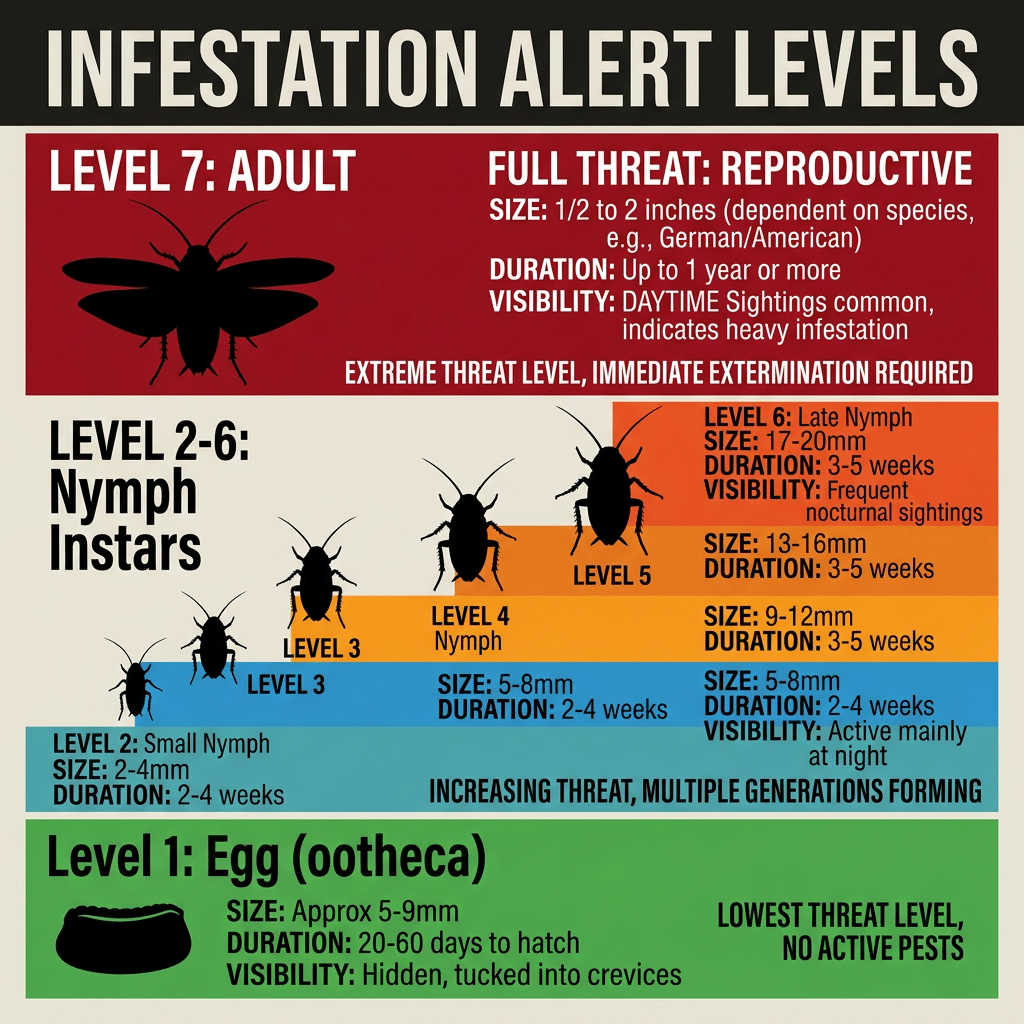
Droppings: German cockroach droppings look exactly like black pepper or coffee grounds — tiny dark specks along cabinet edges, inside drawer corners, behind appliances, and under sinks. American and Oriental cockroach droppings are larger, cylindrical, and blunt-ended.
Shed skins (exuviae): Pale, papery cockroach shells found in corners, behind appliances, or along walls confirm active nymph development — and therefore an actively growing colony.
Egg cases (oothecae): Oval, dark capsules hidden inside cabinet hinges, behind furniture, and inside wall crevices. One German cockroach case holds up to 40 eggs.
Musty or oily odor: Cockroach aggregation pheromones create a persistent musty smell. In serious infestations — particularly German cockroach colonies in kitchens — the smell is strong and noticeable even after cleaning.
Smear marks: Dark brown smear marks along the base of walls and behind kitchen equipment indicate regular cockroach movement through those paths.
Live cockroaches during the day: Nocturnal insects appearing in daylight means the colony is overcrowded. A single daytime sighting is a serious sign.
Dead cockroaches: Finding dead roaches along walls or under appliances indicates an active colony nearby.
What Attracts Cockroaches to Your Property
Remove these conditions before and after treatment to prevent reinfestation.
Food: Open containers, pet food left out, grease behind ovens, unwashed dishes overnight, crumbs in floor seams and counter gaps, unsealed garbage bins.
Moisture: Leaking pipes, dripping faucets, condensation on walls, wet floor mats, standing water in drain trays. A single dripping tap under a sink can sustain a German cockroach colony for months.
Entry and shelter: Gaps around utility pipes, floor drains, cracks in wall bases, spaces under exterior doors, incoming cardboard boxes, cluttered storage areas.
Where Cockroaches Hide Inside Properties
In homes: Inside refrigerator motor compartments, microwaves, coffee machines, and toasters. In rubber door seals around dishwashers. Inside wall insulation near water heaters. Behind bathroom tile grouting near drains. Inside electrical sockets and distribution boxes. Inside bedroom wardrobes and furniture (specifically brown-banded cockroaches).
In commercial properties: Inside walk-in refrigerator door seals and base frames. Beneath commercial fryer and dishwasher units. Inside food storage shelving channels. In delivery holding areas with cardboard buildup. Inside grease trap surrounds and floor drain covers.
Cockroach Control by Property Type in Dubai
Different property types face different cockroach risks. Here’s what each situation requires.
Dubai Villas
Villas present the widest variety of cockroach entry points. American and Turkestan cockroaches enter through garden-level gaps, outdoor drain access points, and utility pipe penetrations in external walls. German cockroaches establish indoors through deliveries and are typically concentrated in kitchen and laundry areas.
Key focus areas: Seal all exterior wall penetrations, install door sweeps on ground-floor doors, treat outdoor drain covers as part of any comprehensive treatment, and address garden compost and waste storage areas that harbor Turkestan cockroaches.
Dubai Apartments
The shared infrastructure of apartment buildings is the central challenge. Cockroaches — especially German roaches — travel between units through shared plumbing, pipe chases, and wall voids. A professionally treated apartment can be reinfested from an adjacent untreated unit within weeks.
Key focus area: Building-wide treatment coordination. Individual apartment treatment alone is rarely sufficient for long-term elimination in multi-unit residential buildings. Speak with building management about coordinated treatment. Request that your pest control provider document the treatment for building management records.
Dubai Restaurants and Food Businesses
The regulatory stakes are highest here. Dubai Municipality health inspections can result in immediate closure for cockroach evidence. For food businesses, cockroach control is a compliance requirement, not a preference.
German cockroaches are the dominant species in food service environments — introduced on supply deliveries and establishing rapidly in kitchen equipment, grease traps, and storage areas. American cockroaches enter through floor drains connected to shared building sewer systems.
Key requirements:
- Monthly or bi-monthly professional treatment
- Full written treatment reports for Dubai Municipality compliance documentation
- Drain treatment as a standard part of every service visit
- Staff training on delivery box inspection protocols
- Immediate reporting of any cockroach sightings to management
Dubai Hotels and Hospitality
Hotels face the challenge of continuous new introductions — guests bring luggage, deliveries arrive constantly, and the sheer volume of rooms and service areas creates extensive hiding opportunities. A single untreated service corridor can distribute cockroaches across an entire floor.
Key requirements: Regular treatment across all kitchen and food preparation areas, storage rooms, service corridors, laundry facilities, and delivery receiving areas. Guest room treatment protocols after any reported sighting. Full Dubai Municipality compliance documentation.
Offices and Commercial Properties
Offices are lower-risk than food businesses but not immune — particularly any office with a kitchen, pantry, or dining area. Brown-banded cockroaches specifically are common in offices because of the dry, warm environment created by electronics and equipment.
Health Risks: What Cockroaches Spread
Bacterial diseases: Cockroaches carry and transfer Salmonella, E. coli, Staphylococcus, and typhoid-causing bacteria to every surface they contact — counters, cooking utensils, and stored food.
Allergens and asthma: Shed skins, droppings, and dead cockroach particles break down into airborne allergens. In Dubai’s air-conditioned buildings, these circulate through HVAC systems across the entire property. Children in cockroach-infested homes show significantly higher rates of asthma hospitalization.
Food contamination: Cockroaches defecate and regurgitate digestive material as they move. Food stored in packaging is not automatically protected.
Regulatory risk: For food businesses, a cockroach sighting during a Dubai Municipality inspection can result in operational closure and license suspension.
Why Supermarket Sprays Don’t Work
Over-the-counter sprays kill cockroaches on direct contact only. They have no residual effectiveness inside wall voids, appliance motors, or drainage systems — the actual nesting locations. Cockroach eggs inside sealed oothecae are naturally protected from spray chemicals by the casing.
On top of that, German cockroaches in the UAE have developed documented genetic resistance to many pyrethroid-based spray chemicals sold in UAE supermarkets. You spray, kill the 5–10% currently visible, the remaining colony retreats slightly, and within weeks you’re back to the same situation — while the colony continues reproducing at full speed.
How Professional Cockroach Treatment Works
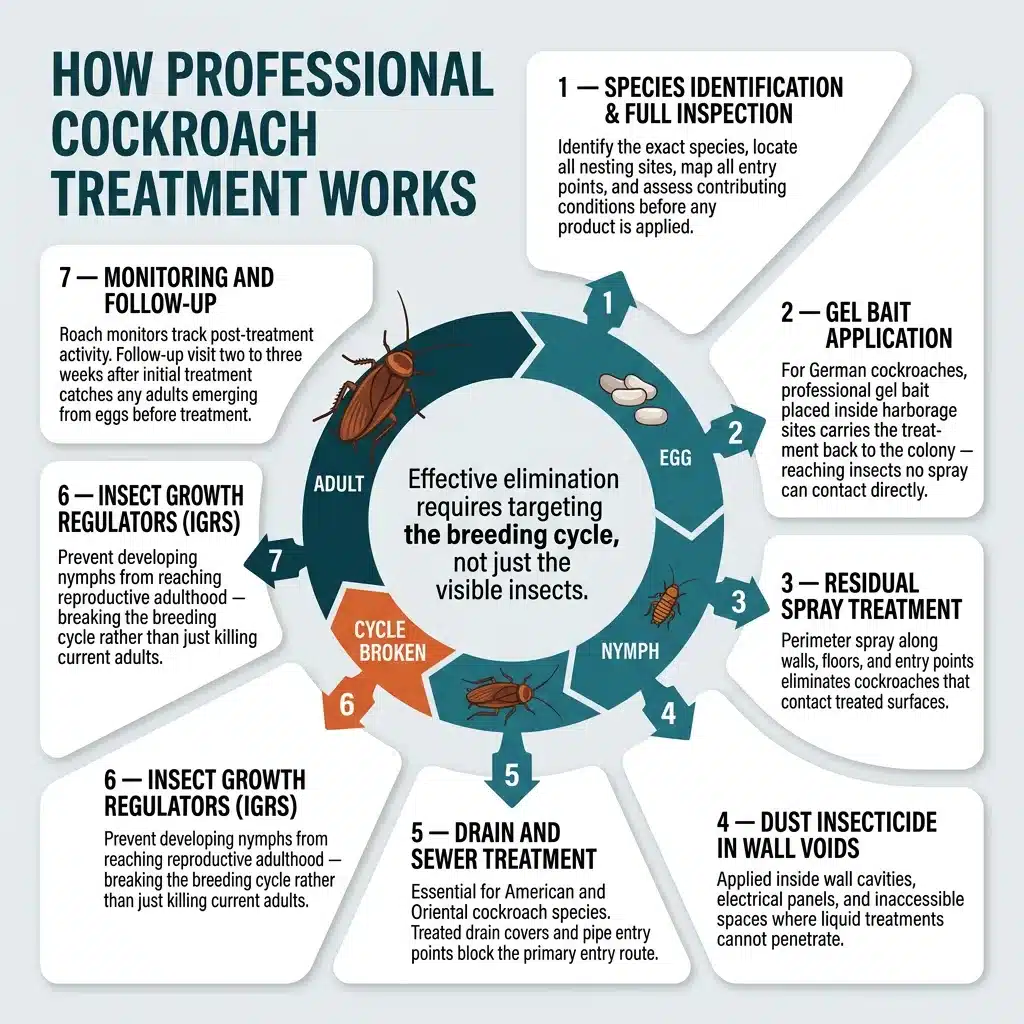
Effective elimination requires targeting the breeding cycle, not just the visible insects.
Step 1 — Species identification and full inspection: Identify the exact species, locate all nesting sites, map all entry points, and assess contributing conditions before any product is applied.
Step 2 — Gel bait application: For German cockroaches, professional gel bait placed inside harborage sites carries the treatment back to the colony — reaching insects no spray can contact directly.
Step 3 — Residual spray treatment: Perimeter spray along walls, floors, and entry points eliminates cockroaches that contact treated surfaces.
Step 4 — Dust insecticide in wall voids: Applied inside wall cavities, electrical panels, and inaccessible spaces where liquid treatments cannot penetrate.
Step 5 — Drain and sewer treatment: Essential for American and Oriental cockroach species. Treated drain covers and pipe entry points block the primary entry route.
Step 6 — Insect Growth Regulators (IGRs): Prevent developing nymphs from reaching reproductive adulthood — breaking the breeding cycle rather than just killing current adults.
Step 7 — Monitoring and follow-up: Roach monitors track post-treatment activity. Follow-up visit two to three weeks after initial treatment catches any adults emerging from eggs laid before treatment.
Post-Treatment Prevention
- Inspect every delivery box and grocery bag before bringing it indoors
- Store all food in sealed airtight containers
- Fix all leaking pipes and dripping faucets immediately
- Clean behind and under all appliances regularly
- Empty indoor bins daily and seal outdoor bin lids
- Seal all utility pipe gaps and cable entries with silicone
- Install door sweeps on all exterior doors
- Eliminate cardboard clutter from storage areas
- Schedule quarterly professional treatments — the most effective long-term strategy in Dubai’s climate
Can Cockroaches Fly?
Some cockroach species can fly — but most rarely do, even when they have wings.
This confuses a lot of Dubai residents. Here’s the clear breakdown by species:
| Species | Wings | Flies? |
| German Cockroach | Both sexes have wings | Almost never |
| American Cockroach | Both sexes fully winged | Occasionally — usually glides downward |
| Oriental Cockroach | Males partial, females none | Never |
| Brown-Banded Cockroach | Males fully winged, females partial | Males fly when disturbed |
| Turkestan Cockroach | Males fully winged, females none | Males fly, especially at night |
Why cockroaches don’t fly even when they can: Running is faster and more controlled for a cockroach than flying. Their legs are extraordinarily efficient on surfaces — they can navigate tight cracks, wall corners, and ceiling joins with ease. Flight is energetically expensive and exposes them to open space and predators. They default to running.
When you do see cockroaches fly in Dubai: American cockroaches occasionally fly or glide indoors during summer months — typically when they’ve been disturbed near an elevated surface. Seeing a large reddish-brown cockroach glide across a room is almost always an American cockroach, not a German one.
For full identification of what you’re dealing with, read our guide to cockroach species in Dubai or book a free inspection so our technician can confirm the species on-site.
Cockroach Myths vs Facts
Misinformation about cockroaches leads to wasted money on treatments that don’t work. Here are the most common myths we hear from Dubai residents.
Myth 1: “If I only see one, I only have one.” Fact: Cockroaches are nocturnal and hide the vast majority of the time. A single visible cockroach typically means hundreds are concealed nearby. The visible 5% is not the infestation — it’s the symptom.
Myth 2: “A clean home won’t get cockroaches.” Fact: German cockroaches are introduced on delivery boxes and grocery bags regardless of how clean the property is. Even immaculate Dubai kitchens get German cockroach infestations. Cleanliness helps maintain conditions but doesn’t prevent introduction.
Myth 3: “Cockroaches only live in dirty or old buildings.” Fact: Some of Dubai’s newest residential towers and five-star hotels have had cockroach infestations. Building age and cleanliness matter less than entry points, delivery volumes, and shared infrastructure.
Myth 4: “Supermarket spray will solve it.” Fact: Spray products kill cockroaches on direct contact only — with zero effect on eggs, nesting sites inside walls, or the 90%+ of the colony that never crosses a treated surface. German cockroaches in the UAE also have documented resistance to many common spray chemicals.
Myth 5: “Cockroaches can survive a nuclear blast.” Fact: This one is partially true — cockroaches can tolerate radiation levels that would kill a human. But they are not indestructible. They die from professional insecticides, extreme cold, and targeted professional treatment when the full breeding cycle is addressed.
Myth 6: “Once treated, they won’t come back.” Fact: Professional treatment eliminates the current infestation. It doesn’t permanently seal every entry point in a building or prevent future introductions. Quarterly preventative treatment combined with exclusion measures is the only reliable long-term strategy in Dubai’s climate.
How Long Does a Cockroach Infestation Take to Develop?
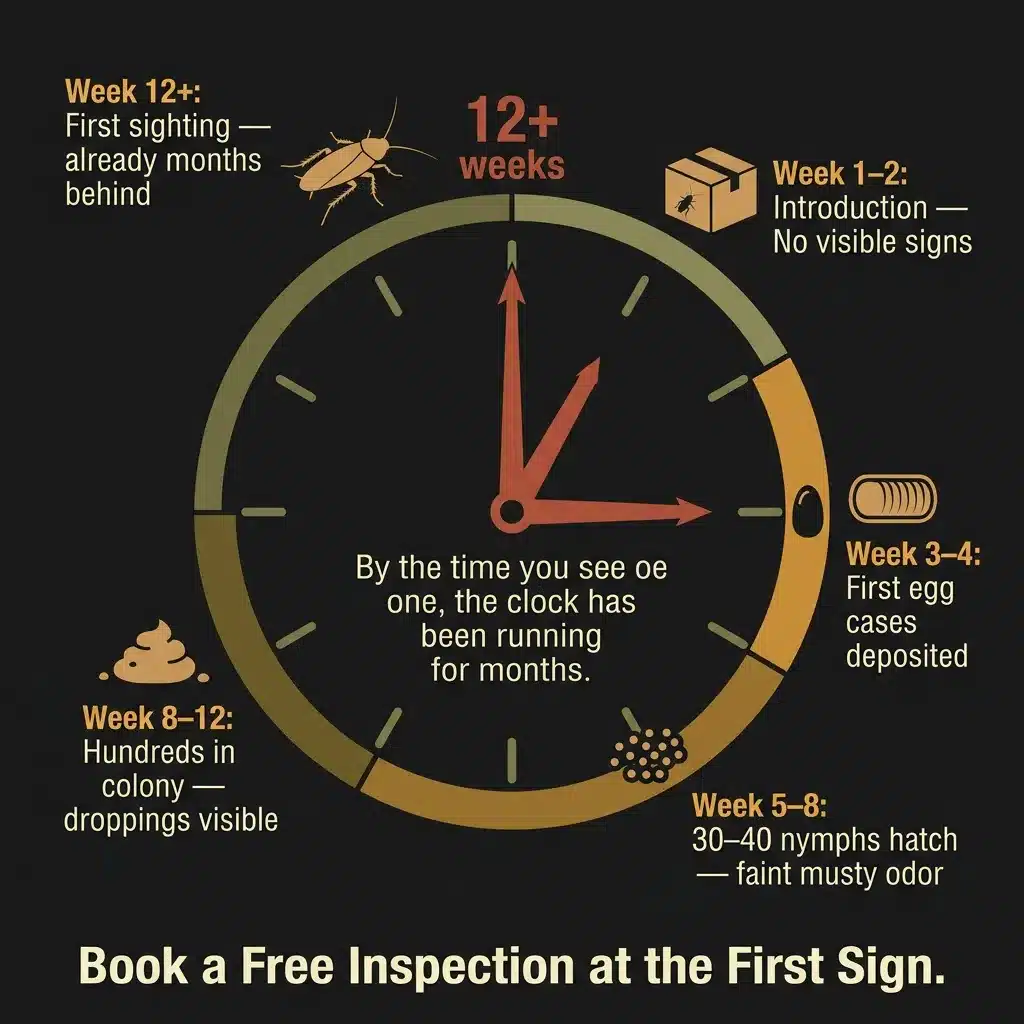
This question matters because it changes how urgently you should act when you spot the first signs.
Week 1–2: A small number of cockroaches are introduced — typically on a delivery box or grocery bag. They find a harborage site (a crack, an appliance motor) and establish. No visible signs yet.
Week 3–4: The first egg cases are deposited. The founding insects begin feeding and producing aggregation pheromones that signal the harborage site as safe. Still no visible signs for most people.
Week 5–8: First egg cases begin hatching. 30–40 nymphs per case join the colony. Droppings begin accumulating in concentrated areas. A faint musty odor may be noticeable in the kitchen at this stage.
Week 8–12: Second generation of egg cases produced. Colony now numbers in the hundreds. Droppings visible to anyone looking carefully. Musty smell stronger. Shed skins appearing.
Week 12+: Colony reaches a size where competition for harborage space begins pushing insects into visible areas. This is typically when residents first see a cockroach in the open — but the infestation has been growing for two to three months at this point.
The key takeaway: By the time you see a cockroach, you are already weeks behind. Early action on any single warning sign — droppings, smell, shed skins — is always better than waiting for a visible insect. Book a free inspection at the first sign rather than waiting for confirm
How Much Does Cockroach Treatment Cost in Dubai?
Cockroach treatment cost in Dubai typically ranges depending on property size, infestation severity, and the number of visits required. Here’s a realistic breakdown.What affects the cost:
- Species: American cockroach infestations requiring drain treatment cost more than German cockroach-only treatments
- Severity: Heavy infestations require higher product volume and follow-up visits
- Property size: Larger surface area and more harborage sites increase treatment time
- Frequency: Quarterly contracts are significantly cheaper per visit than one-off emergency callouts
- Commercial compliance: Restaurant and food business treatments include written Dubai Municipality compliance reports, which adds to the scope
The cost of doing nothing: A German cockroach colony left untreated for three months can grow from a few insects to thousands. At that stage, treatment requires multiple visits, higher product volume, and more time — costing three to four times more than catching it early. For food businesses, a failed Dubai Municipality inspection adds potential closure costs and license complications on top.
Frequently Asked Questions
How do I know if I have cockroaches? Look for dark pepper-like droppings in cabinet corners, pale shed skins behind appliances, oval egg cases in concealed areas, a persistent musty odor in the kitchen, and any live sightings — especially during daytime. Any single sign confirms active infestation.
What is the most common cockroach in Dubai? The German cockroach (Blattella germanica) is the dominant indoor species in Dubai. The American cockroach (Periplaneta americana) is the most common species in drains and commercial kitchen infrastructure.
Why do cockroaches come back after I spray? Spray products only kill cockroaches they directly contact. They don’t reach eggs inside oothecae, nesting sites inside appliance motors, or colonies inside wall voids. German cockroaches in the UAE also have documented resistance to many common spray chemicals. Professional treatment using gel bait and insect growth regulators breaks the full breeding cycle.
How long does professional treatment take to work? Visible results within 24–72 hours. Complete clearance including eggs and developing nymphs takes one to three weeks. Heavy German cockroach infestations typically require a follow-up visit two to three weeks after the initial treatment.
Are treatments safe for children and pets? Yes. Professional treatments use targeted, low-toxicity formulations. Gel baits are placed inside concealed harborage sites. Your Dominator technician will advise on any specific precautions before treatment.
Why are cockroaches worse in Dubai in summer? Summer heat above 40°C drives American cockroaches indoors seeking cooler environments, while simultaneously accelerating the breeding cycle of German cockroaches already established indoors. May through September is the peak season across the UAE.
How often should Dubai properties be treated? Residential properties with a history of cockroach problems: quarterly. Restaurants, hotels, and food businesses: monthly or bi-monthly for Dubai Municipality compliance. Preventative treatment is significantly more cost-effective than managing a severe infestation.
Can I book same-day treatment? Yes. Dominator Pest Control offers same-day and emergency cockroach extermination across Dubai and the UAE. Call or WhatsApp +971 56 968 6078 or book at https://dominatorpestcontrol.ae/
Book Your Free Cockroach Inspection in Dubai
A cockroach infestation does not resolve on its own. The sooner a professional inspection confirms what species you’re dealing with and where they’re nesting, the faster and more straightforward the treatment.
Dominator Pest Control provides certified cockroach extermination across Dubai, Sharjah, Ajman, Abu Dhabi, Ras Al Khaimah, Fujairah, and Al Ain — with eco-friendly formulations, guaranteed results, and full Dubai Municipality compliance documentation.
👉 Book your free inspection: https://dominatorpestcontrol.ae/ 📞 Call or WhatsApp: +971 56 968 6078 ✉️ Email: info@dominator.ae
Available 7 days a week including same-day and emergency service.
Get an accurate quote for your property — Dominator Pest Control provides free inspections across Dubai and the UAE with no obligation.